Fort Bend Tree Guide
Hurricane Season Tree Prep for Fort Bend County
Use a pre-storm tree checklist for Fort Bend County: safe observations, trimming scope, utility boundaries, documentation, and post-storm safety.
- Fort Bend County service territory
- Written scope for comparison
- Coverage confirmed per request

Quick Guide Summary
Start with source-backed guidance and the actual property condition
Quick answer: Before hurricane season, walk the property from safe ground, record broken or dead branches, recent lean, open splits, clearance conflicts, and nearby utilities, then resolve routine trimming or removal questions before a storm is approaching. Do not top trees, do not work near lines, and do not assume pruning makes a tree hurricane-proof. After a storm, treat downed lines and suspended limbs as hazards and document damage from a safe location.
The National Hurricane Center’s climatology page defines the Atlantic hurricane season as June 1 through November 30 and notes that activity can occur outside those dates. A calendar supports planning; it does not predict whether a particular property will be affected.
Guide Step 01
Do a Ground-Level Property Walk Before the Season
Look without climbing, cutting, striking the trunk, or entering a suspected drop zone. Record:
- dead, detached, or hanging branches;
- a fresh split or opening at a major fork;
- a recent change in lean;
- soil lifting or cracking near a tree after wind or saturation;
- branches touching a roof or blocking ordinary access;
- limbs touching or very near overhead lines;
- recent construction, trenching, or grade changes near roots; and
- trees or limbs that could affect a driveway, gate, public walk, street, or neighboring property.
These are observations, not a risk rating or diagnosis. A cavity, mushroom, lean, sparse canopy, or dead branch can have different implications depending on the tree and site. Do not use a checklist to declare a tree safe, diseased, or certain to fail.
The dead-tree guide offers a cautious framework for observing change without treating leaf loss alone as proof.
Guide Step 02
Separate Routine Work From Storm-Eve Decisions
Routine work is easier to define and compare before forecasts create urgency. Identify the exact tree, the objective, nearby property features, access limits, debris expectations, and exclusions in writing.
| Question | Why it belongs in the scope |
|---|---|
| Which tree or branches are included? | “Storm prep” is too broad to define the work. |
| Is the goal dead-branch removal, clearance, or a specific structural concern? | Each goal can produce a different pruning plan. |
| What structures, fences, vehicles, surfaces, or boundaries are nearby? | The property context affects access and consequences. |
| Are utilities or public areas involved? | Responsibility may belong to a utility or municipality rather than a private provider. |
| Are debris hauling, stump work, roots, and surface restoration included? | Adjacent tasks should not be assumed. |
| How will added work be approved? | Storm-related discoveries should not create undocumented scope or price changes. |
Use the tree trimming and pruning page when the request concerns selected limbs or clearance. The tree trimming cost guide helps compare proposals without inventing a price range. If whole-tree removal is being considered, start with the tree removal page and removal cost guide.
Guide Step 03
Pruning Cannot Make a Tree Storm-Proof
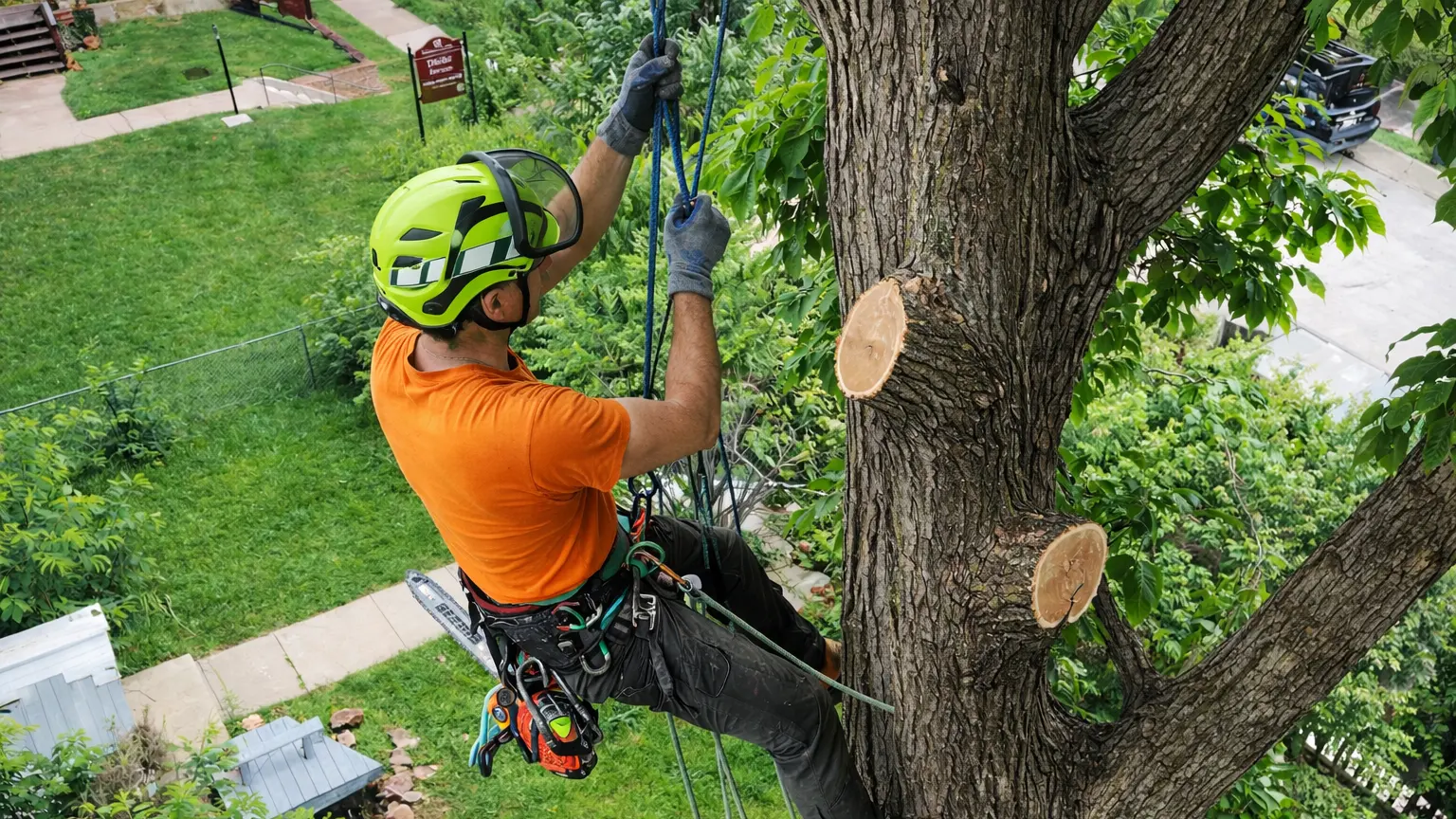
Texas A&M Forest Service explains in its mature-tree pruning guidance that mature-tree pruning should have a defined purpose and warns against removing too much canopy. Its storm-damage guidance says not to top trees; the weakly attached shoots that follow can be more likely to break in a future storm.
Avoid proposals built around “hurricane-proofing,” indiscriminate crown removal, topping, or a guaranteed wind outcome. Wind, rain, soil saturation, previous damage, tree condition, and the surrounding property all vary. A properly described trimming scope may address selected concerns, but no page or provider can promise that a tree or property will escape storm damage.
Oak timing needs an additional safeguard. Texas A&M Forest Service advises avoiding oak pruning from February through June and painting oak wounds immediately regardless of season. Read when to trim oak trees in Texas before scheduling routine oak work.
Guide Step 04
Keep Utility and Emergency Boundaries Clear
A tree or limb touching a power line is not a do-it-yourself or ordinary private-tree-work situation. Keep people and pets away, call 911 for immediate danger, and contact the property’s actual electric utility. Do not touch the tree, line, vehicle, fence, puddle, or other object that may be energized.
Also keep clear of suspended limbs, split trunks, newly leaning trees, and unstable storm debris. If a tree has hit a structure, follow the safety sequence in what to do if a tree falls on your house.
Fort Bend Tree Pros does not claim utility-line work. Its emergency tree service is limited to eligible requests involving fallen trees, broken limbs, storm damage, and blocked access after project location, coverage, scheduling, and scope are confirmed.
Guide Step 05
Prepare Documentation and Consumer Safeguards
Before a storm, photograph the property from safe, ordinary viewpoints and keep policy and utility contact information accessible. After damage, do not enter a dangerous area merely to improve documentation.
The Texas Department of Insurance fallen tree and insurance guidance recommends taking photos before moving a tree or making repairs when it is safe to do so, contacting the insurer promptly, making temporary repairs to limit further damage, and keeping receipts. Coverage depends on the policy and circumstances; only the insurer or agent can decide a claim.
The Texas Attorney General’s disaster scams guidance recommends getting more than one estimate, resisting pressure to sign immediately, researching the contractor, and keeping written records. The provider-selection guide turns those principles into a tree-work comparison checklist.
Guide Step 06
After the Storm, Use a Safety-First Order
- Check for immediate danger, fire, injury, entrapment, blocked emergency access, and lines.
- Call 911 for immediate danger and contact the actual utility for line concerns.
- Keep people and pets outside the affected area.
- Observe and photograph only from a safe location.
- Contact the insurer promptly when covered property may be involved.
- Separate temporary safety work from permanent trimming, removal, stump, and restoration decisions.
- Compare written scopes when conditions allow.
Texas A&M Forest Service advises against rushed removal decisions for borderline storm-damaged trees in its Can My Tree Be Saved? guide. This page does not decide whether a particular tree can be retained.
Prepare Once, Compare Better
Turn the property details into a clearer first conversation
Share the private service location, what you can observe safely, nearby property or access constraints, and the outcome you want to discuss. A written scope should define inclusions, exclusions, timing, and how changes are approved.
- Use one description for every estimate request.
- Photograph only from a safe location.
- Identify utility, public-area, and access concerns early.
- Compare the proposed result—not the total alone.
Prefer to call? (281) 953-6277
Common Questions
Practical guide questions
Use these answers as a starting point, then confirm the exact property, responsibility, and written scope.
When is Atlantic hurricane season in Texas?
The National Hurricane Center defines the Atlantic hurricane season as June 1 through November 30, while noting that tropical cyclone activity can occur outside those dates.
Should trees be topped before a hurricane?
No. Texas A&M Forest Service warns against topping. The resulting shoots can be weakly attached and more likely to break in a later storm.
Does pruning guarantee that a tree will survive a hurricane?
No. A defined pruning scope may address selected dead branches, clearance, or structural objectives, but wind, rain, soil, tree condition, and storm intensity vary. No trimming plan makes a tree hurricane-proof.
What should I do if a storm-damaged tree is near a power line?
Stay away from the tree, line, and nearby objects that may be energized. Call 911 for immediate danger and contact the property’s actual electric utility. Do not begin private tree work until the utility hazard and responsibility are resolved.
Request a Scope-Based Estimate
Request a Written Scope for Approved Tree Work
Describe the visible concern and intended outcome. Fort Bend Tree Pros will confirm service-area coverage and whether more information or an on-site review is needed before the written scope and price are finalized.