Tree Condition Guide
How to Tell If a Tree Is Dead Without Jumping to Conclusions
Learn which signs may point to a dead or damaged tree, why leaf loss is not conclusive, what you can check safely, and when to seek appropriate help.
- Fort Bend County service territory
- Written scope for comparison
- Coverage confirmed per request
Quick Observation Summary
One visible clue is not a diagnosis
Quick answer: A leafless canopy alone does not prove that a tree is dead. Look at timing, recent drought or storm damage, visible trunk splits, extensive crown loss, and whether small, safely reached twigs show living green tissue beneath a light scrape. Do not climb, cut major limbs, or approach a hazardous tree to test it. One clue is not a diagnosis, and a large or damaged tree may need appropriate professional evaluation.
The practical goal is not to label a tree from one symptom. It is to decide whether the condition can be watched safely, whether more information is needed, or whether the tree creates a reason to keep people away and escalate the concern.
Observation Guide 01
First Ask What Changed and When
A good observation starts with a timeline. Did the tree lose leaves during drought? Did a storm remove branches? Has the canopy failed to leaf out when comparable trees have? Did a trunk split or lean appear suddenly? The same visible condition can mean different things depending on season and recent events.
Texas A&M Forest Service explains in its trees and drought guidance that drought-related leaf drop does not by itself mean a tree is dead. Early leaf loss can be a stress response. That fact is useful because it prevents a hasty removal decision, but it does not establish that every leafless tree is healthy.
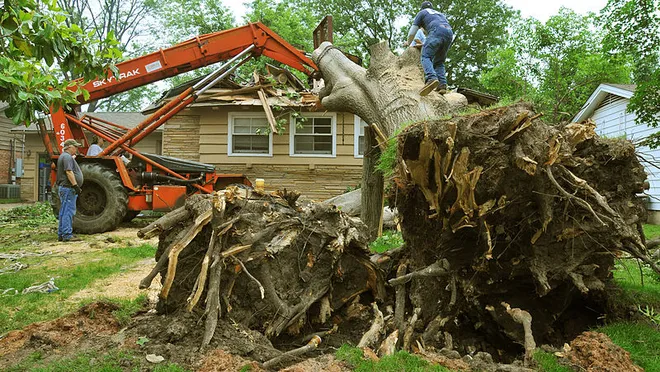
After a storm, the agency similarly cautions in its storm-damage tree care guidance that rushed cleanup decisions can remove trees that might have been saved. Immediate hazards still come first. Once the area is safe, the keep, monitor, prune, or remove decision deserves a fuller look.
Observation Guide 02
Safe Clues You Can Observe From the Ground
Stay outside the drop zone of broken or suspended limbs. Never stand under a damaged canopy, climb to reach a branch, or approach a tree that is touching or near a power line. From a safe location, note several categories rather than relying on one sign.
Leaf and bud activity
Consider whether the tree is deciduous, what season it is, whether drought has occurred, and whether other trees of the same kind are behaving similarly. A tree may be naturally bare in its dormant period or may shed leaves under stress. Look for buds or new growth only where they can be seen without entering a dangerous area.
Crown condition after damage
Texas A&M Forest Service’s Can My Tree Be Saved? guide identifies crown loss, remaining branches, wound size, structural damage, the tree’s prior health, and location among the factors to consider after a storm. Extensive crown or leaf loss is a concern, especially when paired with trunk damage, but the percentage visible from the ground is not a stand-alone verdict.
Trunk splits and major breaks
A split trunk is a serious escalation sign in the Forest Service decision framework. A split or large break can change the structural question even when part of the canopy still has leaves. Do not probe a crack, pull on a branch, or stand where movement could place you beneath the tree.
A limited twig check for a small, accessible tree
For a small tree with a small twig that can be reached from stable ground, Texas A&M Forest Service says green tissue beneath a lightly scraped twig can indicate that the tree is alive. Keep the limits clear:
- use only a small, safely reached twig;
- make a light scrape rather than a deep cut;
- do not test a trunk or major branch;
- do not climb or use a ladder; and
- do not treat the absence of green in one twig as proof that the whole tree is dead.
A tree can have localized dieback. The check provides one piece of information, not a complete condition assessment.
Observation Guide 03
What the Clues Can and Cannot Tell You
It helps to sort observations into three decision groups.
| Observation | What it may tell you | What it does not prove |
|---|---|---|
| Leaf drop during drought | The tree may be responding to water stress. | That the tree is dead or certain to recover. |
| Green tissue under a small scraped twig | That tested twig has living tissue. | That the entire tree is structurally sound. |
| No green in one small twig | The twig may be dead or in decline. | That every part of the tree is dead. |
| Extensive crown loss after a storm | The tree deserves closer consideration. | That removal is automatically required. |
| A split trunk or major broken branch | The condition may present a serious structural concern. | That a homeowner can safely determine the full response from the ground. |
| A tree near a house, drive, or line | Failure could affect people, access, or property. | Who has legal responsibility or whether private tree work can proceed. |
This distinction matters because “dead,” “declining,” and “hazardous” are not interchangeable labels. A living tree can have serious structural damage. A dead small tree in an open area presents a different immediate exposure from a large damaged tree above a roof or access route.
Observation Guide 04
When to Stop Observing and Keep Away
Do not continue a do-it-yourself check when the act of checking increases risk. Keep people and pets away and seek the appropriate response when you see or suspect:
- a downed or nearby utility line;
- a trunk that split or shifted during a storm;
- a large branch hanging above an occupied or traveled area;
- a tree or limb resting on a structure;
- blocked access that affects safe entry or exit; or
- damage that cannot be viewed without climbing or standing beneath the canopy.
If a line is down or a tree is touching a line, treat the area as energized. Call 911 for immediate danger and contact the property’s actual electric utility. Fort Bend Tree Pros does not perform utility-line work.
For a tree that has fallen onto a structure, follow the sequence in What to Do If a Tree Falls on Your House. Life and utility hazards take priority over photographs, estimates, and cleanup decisions.
Observation Guide 05
Deciding Between Monitoring, Trimming, and Removal
The right service question follows the condition question. A healthy-looking canopy does not erase a trunk split, and a bare canopy does not automatically require removal. When the area is safe enough for a decision, frame the next conversation around the desired outcome.
Monitoring may be reasonable when the concern is seasonal or drought-related and no immediate hazard is apparent, but this guide cannot determine that for a specific tree. Tree trimming and pruning may be the relevant service when the question involves selected dead branches, clearance, or storm-damaged limbs rather than the entire tree. Tree removal is the primary service page when the decision concerns taking down the whole tree.
Before accepting a removal proposal, review what shapes a tree removal estimate. A written scope should identify the exact tree, intended work, access and nearby-property constraints, utility or public-area issues, exclusions, scheduling terms, payment terms, and the process for approving a change. Stump work and final site condition should be stated rather than assumed.
Observation Guide 06
Prepare Useful Information Without Taking Risks
A concise description can make the first conversation clearer. From a safe place, record:
- the property location and whether it falls within the Fort Bend County service territory;
- the species if known, without guessing;
- when leaves, lean, cracks, or branch loss were first noticed;
- whether drought, construction, or a recent storm preceded the change;
- what the tree could affect, such as a home, drive, fence, street, or access point;
- whether a utility line or public right-of-way may be involved; and
- what you want to discuss: monitoring questions, trimming, removal, or storm-related access.
Photos can be helpful only when they can be taken without entering a damaged area or standing beneath a suspect branch. Do not cut into the tree, move debris, or climb for a better view.
Fort Bend Tree Pros accepts estimate requests for approved tree services at eligible Fort Bend County properties, with project location and scheduling confirmed for each request. Review the Fort Bend County service-area information and contact Fort Bend Tree Pros or call (281) 953-6277. The approved service scope does not include disease diagnosis or treatment.
Prepare Once, Compare Better
Turn safe observations into a clearer first conversation
Share the private service location, what you can observe safely, nearby property or access constraints, and the outcome you want to discuss. A written scope should define inclusions, exclusions, timing, and how changes are approved.
- Use one description for every estimate request.
- Photograph only from a safe location.
- Identify utility, public-area, and access concerns early.
- Compare the proposed result—not the total alone.
Prefer to call? (281) 953-6277
Common Questions
Practical guide questions
Use these answers as a starting point, then confirm the exact property, responsibility, and written scope.
Does a leafless tree mean it is dead?
No. Texas A&M Forest Service says drought-related leaf drop alone does not mean a tree is dead, and deciduous trees also have naturally leafless periods. Consider the season, recent weather, other signs of growth, and any structural damage before deciding what to do.
Can I use a scratch test to check a tree?
For a small tree with a small twig safely reachable from stable ground, a light scrape that reveals green tissue can indicate that the twig is alive. Do not climb, cut a trunk or major branch, or assume that one brown twig proves the whole tree is dead.
What signs make a damaged tree more urgent?
A split trunk, extensive crown loss, major broken or suspended limbs, a sudden lean, contact with a structure, blocked access, or proximity to a downed line should move the issue from casual observation to safety-first escalation.
Should every storm-damaged tree be removed?
No. Texas A&M Forest Service warns that rushed post-storm decisions can remove trees that might have been saved. After immediate hazards are controlled, the decision should consider the tree’s prior condition, structural damage, crown loss, wounds, remaining branches, and location.
Can Fort Bend Tree Pros diagnose why my tree is declining?
Disease diagnosis and treatment are not in the approved Fort Bend Tree Pros service catalog. Estimate requests may cover tree removal, trimming and pruning, stump grinding, or emergency response for fallen trees, broken limbs, storm damage, and blocked access, subject to confirmed property coverage and scheduling.
Request a Scope-Based Estimate
Describe the Visible Concern Without Taking Unnecessary Risks
Describe the visible concern and intended outcome. Fort Bend Tree Pros will confirm service-area coverage and whether more information or an on-site review is needed before the written scope and price are finalized.