Storm-Damage Safety Guide
What to Do If a Tree Falls on Your House
After a tree hits your house, avoid utility hazards, call 911 when needed, document safely, contact your insurer, and compare written tree-service scope.
- Fort Bend County service territory
- Written scope for comparison
- Coverage confirmed per request
Immediate Safety Summary
Life, utility, and structural hazards come first
Quick answer: Move people and pets away from the fallen tree and damaged part of the house. Treat any downed or nearby power line as energized, call 911 when there is immediate danger, and contact the property’s actual electric utility. Photograph damage only from a safe location, contact the insurer promptly, make only safe temporary repairs needed to limit additional damage, save receipts, and do not assume the policy covers tree removal.
Tree-service calls, estimates, and cleanup questions come after life, electrical, and structural hazards. A tree on a house can shift, suspended branches can fall, and electricity can travel through the tree or nearby objects. Do not approach the scene simply to get a better picture.
Safety Step 01
1. Get Everyone Away From the Impact Area
Move people and pets to a safe place. Avoid rooms beneath the impact, the outside drop zone, and any path below broken or hanging limbs. If anyone is trapped, fire is present, or the structure appears to be collapsing, call 911.
Do not re-enter a visibly damaged area to retrieve belongings. Wait for emergency responders or the appropriate building or structural professional to address occupancy safety. A tree service handles the verified tree-work portion, not emergency rescue, utility control, or a building-safety determination.
Safety Step 02
2. Treat Every Downed Line as Energized
Oncor’s fallen power-line safety guidance says to treat downed lines as energized, keep people and pets away, call 911, avoid touching a person or object in contact with the line, and never remove a limb touching or near a downed line.
Electricity can travel through the ground, tree limbs, fences, hoses, and other nearby objects. That means a person does not have to touch the wire itself to be injured. Keep back, warn others away, and contact the property’s actual electric utility. Do not assume which utility serves the address, and do not rely on a service-area selector as substantive safety instruction.
Fort Bend Tree Pros does not perform utility-line work. Private tree work should not start until the utility or emergency authority has addressed the line-related hazard.
Safety Step 03
3. Call 911 When the Situation Is an Emergency
Call 911 when a person is injured or trapped, a line is down, fire or another immediate life-safety threat is present, or public access is dangerously affected. Describe what happened from a safe location. Do not attempt a rescue through a tree or wire hazard unless emergency dispatch instructs you.
If the scene is stable enough that no immediate emergency exists, continue to keep the impact area closed. A fallen trunk or branch can move as weight shifts, damaged supports give way, or wind changes.
Safety Step 04
4. Document the Damage Only When It Is Safe
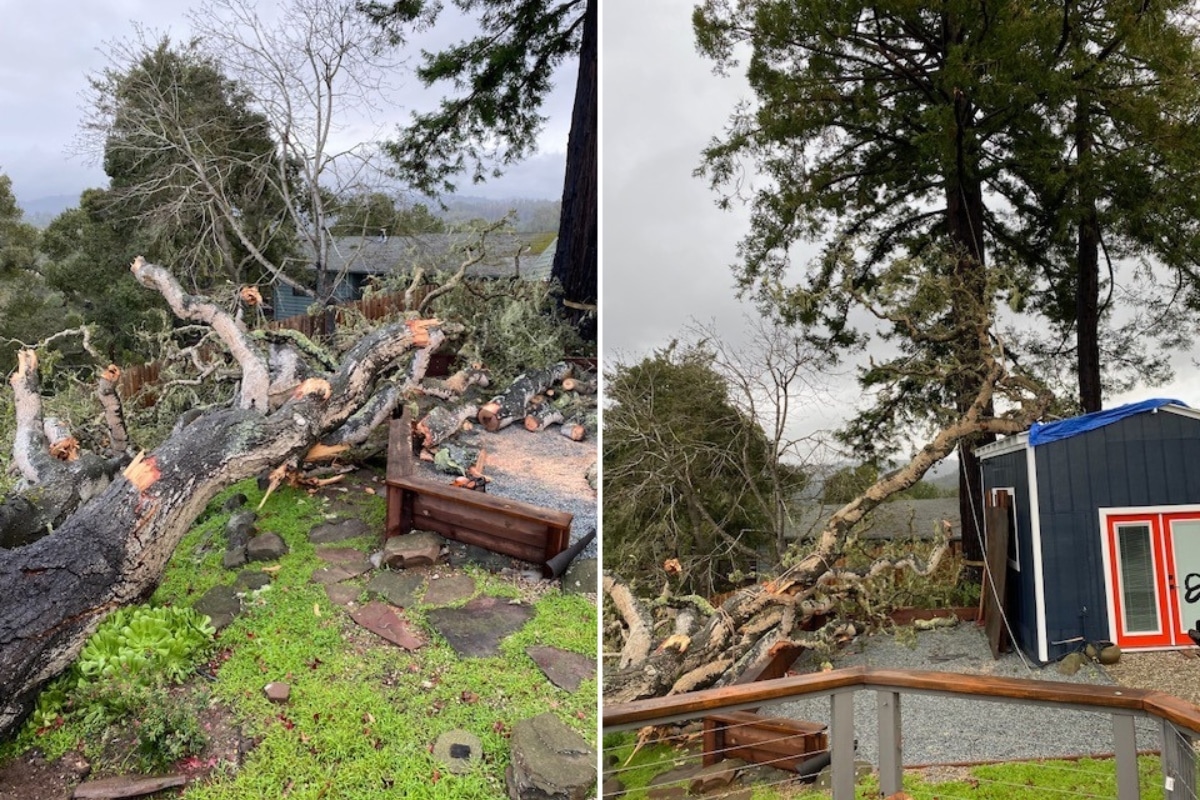
The Texas Department of Insurance advises taking photos before moving the tree or making repairs. Its fallen tree branches and insurance guidance also recommends contacting the agent or insurer promptly and saving receipts.
From a safe location, useful documentation may include:
- a wide view of where the tree landed;
- visible roof, wall, window, fence, drive, vehicle, or other property damage;
- the position of the trunk and major branches;
- the area before any safe temporary repair; and
- receipts and written records for emergency or temporary work.
Do not climb onto a roof, enter a damaged room, step over a line, stand beneath suspended wood, or move the tree to improve a photograph. Tell the insurer when a hazard prevented more detailed documentation.
Safety Step 05
5. Contact the Insurer or Agent Promptly
Texas Department of Insurance guidance says many policies cover some falling-object damage, but tree-removal coverage varies with the circumstances. Contact the insurer or agent to ask what the specific policy covers and what documentation or inspection process it requires.
Questions may include:
- What damage should be photographed before anything is moved?
- Does the insurer need to inspect before tree work or temporary repairs?
- Which temporary steps are appropriate to prevent additional damage?
- What receipts, estimates, or written scopes should be retained?
- Does the policy address removal from the structure, removal from the property, or both?
- How should damage to other structures or vehicles be handled?
This page cannot determine coverage. The cause of the fall, the damaged property, policy wording, deductibles, limits, and other facts may affect the insurer’s answer.
Safety Step 06
6. Make Only Safe Temporary Repairs
Texas Department of Insurance recommends making temporary repairs to prevent additional damage and keeping receipts. That may mean arranging a safe temporary cover or other limited measure after electrical and structural hazards are controlled.
Do not personally tarp a roof, board an opening, or move a trunk when doing so requires climbing, entering an unstable area, working beneath the tree, or approaching a line. Ask the insurer what documentation it needs and use an appropriate provider for the specific repair. Temporary protection is not the same as a permanent structural repair.
Safety Step 07
7. Separate the Immediate Tree Problem From Later Decisions
Texas A&M Forest Service warns in its storm-damage tree care guidance that rushed decisions can remove trees that might have been saved. That caution applies after immediate hazards have been handled; it does not mean leaving a dangerous tree on a structure.
Its Can My Tree Be Saved? guide identifies prior health, hazard, structural damage, crown loss, wounds, remaining branches, and location as decision factors. A split trunk and extensive crown loss are serious warning conditions, but this article cannot decide whether a particular remaining tree should be kept, monitored, trimmed, or removed.
Break the situation into distinct questions:
- What must happen now to protect life and control utility hazards?
- What tree or limb work is needed to provide safe access to the damaged structure?
- What later tree removal or trimming decision remains after the immediate response?
- Is stump grinding relevant after removal, or is it a separate future decision?
- Which building, roofing, vehicle, fence, or other repairs require a different provider?
A clear separation helps the insurer, tree-service provider, and repair providers describe their own scopes without overlap or assumptions.
Safety Step 08
8. Request a Written Tree-Service Scope
When the utility and emergency boundaries are resolved, the emergency tree service page covers requests involving fallen trees, broken limbs, storm damage, and blocked access. The tree removal page is the primary service owner when whole-tree removal is the main decision.
A written estimate should address:
| Scope item | What to clarify |
|---|---|
| Exact tree or limb | Identify what is included rather than using a broad whole-property description. |
| Immediate objective | Separate access or hazard-related work from later removal, trimming, stump, and repair decisions. |
| Utility status | Confirm that the actual utility has addressed any line-related hazard before private work. |
| Structures and boundaries | Note the house, fences, vehicles, neighboring property, streets, and access limits that affect the proposal. |
| Debris and cut material | State what happens to material instead of assuming hauling or cleanup. |
| Stump | Say whether stump grinding is included, excluded, or a separate proposal. |
| Schedule and payment | Put timing, payment stages, and completion conditions in writing. |
| Changes | Explain how added work and price changes will be documented before proceeding. |
This is a comparison checklist, not a statement that every item is included in Fort Bend Tree Pros service.
Safety Step 09
9. Compare Estimates Without Disaster Pressure
The Texas Attorney General’s disaster scam guidance advises getting more than one estimate, avoiding pressure to sign immediately, researching the provider, and keeping written records. It also recommends putting the cost, work scope, schedule, payment terms, and other expectations in writing.
Compare proposals on the same requested result. A lower total may omit trunk removal, debris handling, stump work, access constraints, or later work included elsewhere. Do not sign a document with blanks, and make sure important verbal statements appear in the written agreement.
Use the tree removal cost guide to prepare a like-for-like comparison. It explains estimate factors without an unsupported average price.
Safety Step 10
10. Prepare the First Tree-Service Call
From a safe location, provide the private property address, what happened, whether the tree is on the structure or blocking access, whether a line is present, and whether emergency responders or the utility have addressed the scene. Mention insurer instructions that affect documentation or timing.
Do not state that the area is safe unless the relevant authority has cleared the hazard. Do not move the tree before insurer documentation when doing so is not required for life safety or additional-damage prevention.
For an eligible property within the Fort Bend County service territory, contact Fort Bend Tree Pros or call (281) 953-6277 to request an estimate. Project location, scheduling, availability, and the final tree-service scope require confirmation for each request.
Prepare Once, Compare Better
Contact a tree service only after immediate hazards are addressed
Share the private service location, what you can observe safely, nearby property or access constraints, and the outcome you want to discuss. A written scope should define inclusions, exclusions, timing, and how changes are approved.
- Use one description for every estimate request.
- Photograph only from a safe location.
- Identify utility, public-area, and access concerns early.
- Compare the proposed result—not the total alone.
Prefer to call? (281) 953-6277
Common Questions
Practical guide questions
Use these answers as a starting point, then confirm the exact property, responsibility, and written scope.
Who should I call first when a tree falls on my house?
Call 911 first when anyone is injured or trapped, a line is down, fire is present, or another immediate life-safety threat exists. If a utility line is involved, keep away and contact the property’s actual electric utility before private tree work.
Should I take photos before the tree is moved?
Texas Department of Insurance advises taking photos before moving the tree or making repairs, but only when it is safe. Do not enter a damaged area, climb, stand beneath broken limbs, or approach a line to document the loss.
Will homeowners insurance pay for tree removal?
Coverage varies with the policy and circumstances. Texas Department of Insurance advises asking the agent or insurer whether the policy pays for the damage and any tree-removal work. This page cannot determine coverage.
Can I cut branches away from a downed power line?
No. Treat the line as energized, keep people and pets away, call 911 when there is immediate danger, and contact the actual electric utility. Do not touch or remove a limb that is touching or near the line.
What should a storm-related tree estimate include?
The written estimate should identify the exact tree or limb, immediate objective, utility status, structures and access constraints, included and excluded work, debris and stump terms, schedule, payment terms, and how changes will be approved.
Request a Scope-Based Estimate
When Immediate Hazards Are Controlled, Request a Written Scope
Describe the visible concern and intended outcome. Fort Bend Tree Pros will confirm service-area coverage and whether more information or an on-site review is needed before the written scope and price are finalized.