Fort Bend Tree Guide
Is Bradford Pear Banned in Texas?
Texas has no statewide ownership ban for Bradford pear. Learn the invasive concerns, weak forks, and how to plan a responsible replacement.
- Fort Bend County service territory
- Written scope for comparison
- Coverage confirmed per request
Quick Guide Summary
Start with source-backed guidance and the actual property condition
Quick answer: The authoritative Texas sources cited in this guide do not establish a statewide law that makes an existing Bradford pear illegal to own. Bradford pear is a cultivar of Callery pear, and the Texas Invasive Plant Database identifies Callery pear as a species known or suspected to cause invasive problems. That ecological concern is not the same thing as an ownership ban or an automatic requirement to remove every tree.
If a nursery, homeowners association, city, or deed restriction affects a planting decision, verify the current rule with that specific authority. Do not rely on a headline about a “ban” as legal advice.
Guide Step 01
Why Bradford Pear and Callery Pear Are Discussed Together
Bradford is one cultivated form of Callery pear (Pyrus calleryana). The Texas Invasive Plant Database lists “Bradford pear” as a synonym associated with its Callery pear record and describes how escaped Callery pears can form dense growth that displaces other vegetation.
That creates two separate homeowner questions:
- Should a new Callery pear cultivar be planted? The invasive-species concern is a strong reason to compare noninvasive alternatives.
- What should happen to an existing Bradford pear? That depends on the tree’s location, visible condition, branch structure, property targets, and the owner’s landscape plan. A database listing alone does not diagnose an individual tree or prove that it is an immediate hazard.
Guide Step 02
The Structural Concern Is Real, but Failure Is Not a Countdown
Bradford pears commonly develop multiple upright stems and narrow branch unions. A tight fork may include bark between stems rather than forming a stronger wood connection. Storm loading can expose those weak unions, particularly as the crown becomes larger.
A property owner can safely look from the ground for:
- several large stems arising from one tight point;
- an existing split or opening at a major fork;
- a recently broken leader or large limb;
- dead or hanging branches;
- a recent change in lean; and
- a canopy extending over a roof, parking area, walk, fence, or neighboring property.
These observations are reasons to seek an appropriate assessment, not a diagnosis. Avoid the legacy claim that every Bradford pear “will fail” within a set number of years. Tree condition and consequences vary, and a web page cannot set a removal deadline for a specific tree.
If a limb is hanging, a trunk has split, or access is blocked after a storm, keep people and pets out of the drop zone. Review the emergency tree service page for eligible fallen-tree, broken-limb, storm-damage, or blocked-access requests. Contact 911 for immediate danger and the actual utility if a line is involved.
Guide Step 03
Keep, Prune, or Remove: Frame the Decision Carefully
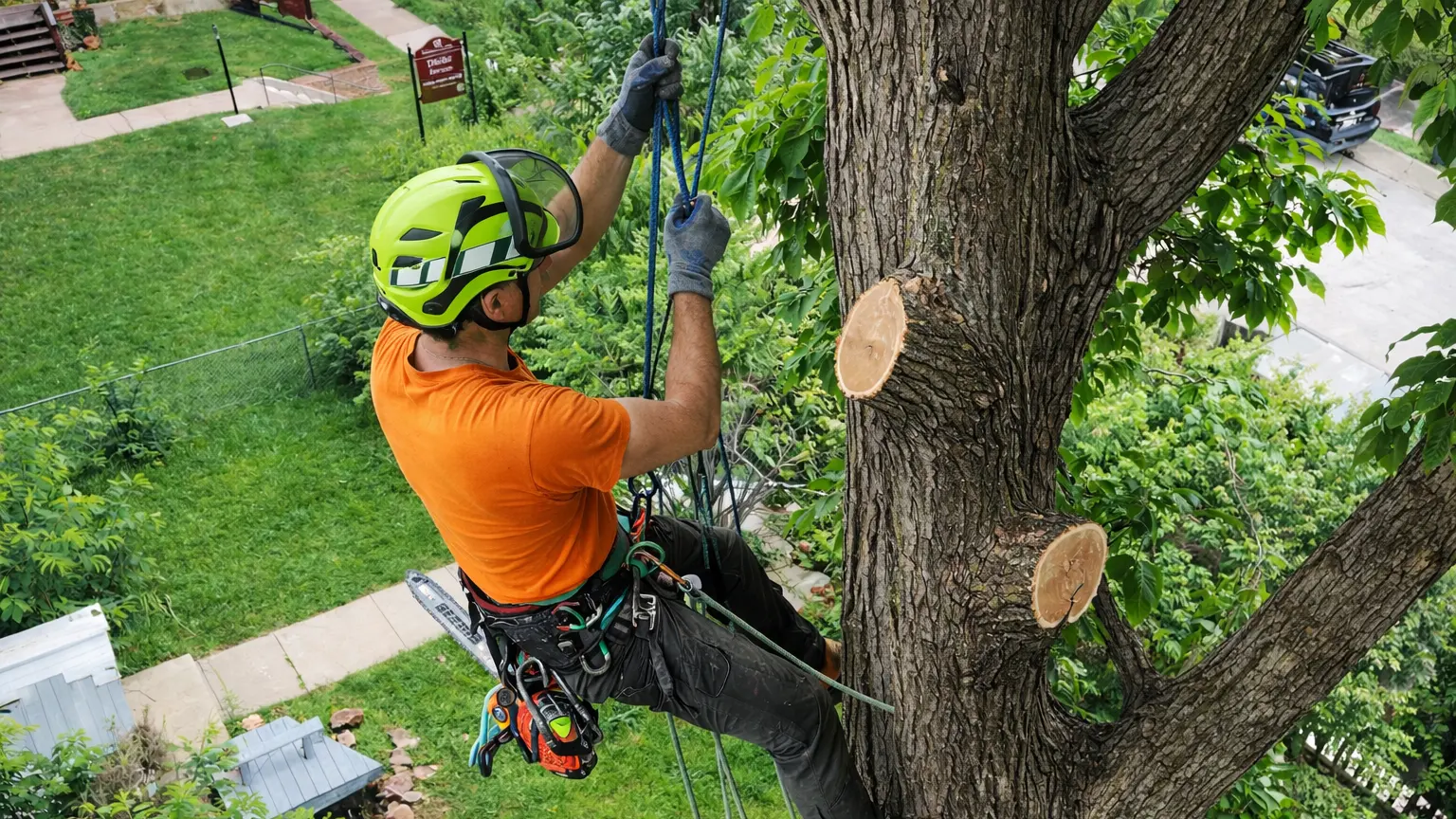
Start with the problem rather than a predetermined outcome.
| Situation | Question to resolve |
|---|---|
| No visible break and adequate clearance | Is the tree’s location and structure acceptable for continued observation? |
| Selected branches conflict with a structure or access route | Is a clearly defined trimming scope appropriate, and what will the finished crown look like? |
| A major fork has opened or a large stem has failed | Is the remaining tree stable enough to retain, and what immediate safety boundary is needed? |
| The tree conflicts with a replacement or property plan | Does removal make sense independent of an emergency claim? |
| A line, public right-of-way, or boundary is involved | Which utility, municipality, neighbor, or other party must be consulted first? |
Do not top the tree or remove large portions of the crown as a shortcut. Texas A&M Forest Service storm-damage guidance warns against topping because the resulting shoots can be weakly attached. Its mature-tree pruning guidance also explains why pruning cuts and scope require care.
The tree trimming and pruning page explains the currently approved service path. When whole-tree removal is the decision under consideration, use the tree removal page and removal cost guide to define and compare the written scope.
Guide Step 04
Replacement Planning Should Come Before the Stump Is Gone
If removal is selected, decide what the area should do next. Is the goal a large shade canopy, spring flowers, a smaller ornamental form, or open space? Check available rooting area, mature crown size, drainage, overhead lines, and underground utilities.
The Texas A&M Forest Service Texas Tree Selector lets users explore trees by county and site characteristics. Depending on the property, candidates to investigate may include Texas redbud for a smaller flowering form or cedar elm, live oak, Shumard oak, or bald cypress where a larger canopy and the site conditions are appropriate. These are research candidates, not universal replacements.
Read the Fort Bend County shade-tree guide before buying. If the old stump conflicts with the new use, the stump grinding guide explains questions about depth, roots, grindings, and the intended finish.
Guide Step 05
What Fort Bend Tree Pros Does—and Does Not—Claim
Fort Bend Tree Pros is not presented here as an arborist, invasive-species authority, landscape designer, nursery, or provider of tree-health diagnosis. This page does not say the business can certify whether a Bradford pear is safe or prescribe treatment.
For an eligible Fort Bend County property, request an estimate for a defined tree removal, trimming and pruning, stump grinding, or emergency tree-work scope. Project location, coverage, scheduling, and the written work description must be confirmed.
Prepare Once, Compare Better
Turn the property details into a clearer first conversation
Share the private service location, what you can observe safely, nearby property or access constraints, and the outcome you want to discuss. A written scope should define inclusions, exclusions, timing, and how changes are approved.
- Use one description for every estimate request.
- Photograph only from a safe location.
- Identify utility, public-area, and access concerns early.
- Compare the proposed result—not the total alone.
Prefer to call? (281) 953-6277
Common Questions
Practical guide questions
Use these answers as a starting point, then confirm the exact property, responsibility, and written scope.
Is it illegal to own a Bradford pear tree in Texas?
The authoritative Texas sources cited here do not establish a statewide ownership ban. Rules from a city, homeowners association, nursery, or deed restriction should be checked directly with the authority that controls the specific property or transaction.
Is Bradford pear the same as Callery pear?
Bradford pear is a cultivated form of Callery pear, or Pyrus calleryana . The Texas Invasive Plant Database associates Bradford pear with its Callery pear record.
Does every Bradford pear need to be removed immediately?
No automatic removal rule is established here. Consider visible condition, branch unions, recent failures, nearby targets, property plans, and any applicable local rule. Keep people away and escalate promptly when a split, hanging limb, line contact, or other immediate hazard is present.
Can Fort Bend Tree Pros diagnose whether my Bradford pear is hazardous?
No diagnosis, arborist assessment, or tree-health service is approved for this page. The business may receive requests for defined removal, trimming, stump grinding, or eligible emergency tree work after location, coverage, scheduling, and scope are confirmed.
Request a Scope-Based Estimate
Request a Written Scope for Approved Tree Work
Describe the visible concern and intended outcome. Fort Bend Tree Pros will confirm service-area coverage and whether more information or an on-site review is needed before the written scope and price are finalized.