Stump Grinding Cost Guide
What Determines a Stump Grinding Estimate in Fort Bend County?
Prepare for a stump grinding estimate in Fort Bend County by defining the stump, access, depth, roots, grindings, exclusions, and intended finish in writing.
- Fort Bend County service territory
- Written scope for comparison
- Coverage confirmed per request

Quick Cost Summary
Define the stump, access, and intended finish
Quick answer: A stump grinding estimate should be built around the exact stump and the intended result—not a generic price per yard. The proposal should identify how many stumps are included, where they are, how the area can be reached, the agreed grinding-depth expectation, which visible roots are in scope, what happens to grindings or debris, the expected surface condition, scheduling, and how changes are approved. Fort Bend Tree Pros does not publish an unverified price range.
For an eligible property in the Fort Bend County service territory, request a stump grinding estimate after preparing the details below. Coverage, scheduling, scope, and price require confirmation.
Cost Guide 01
Begin With What You Want to Do With the Space
A remaining stump can be an obstacle, but the desired outcome differs from one property to another. One owner may want to reduce a lawn obstruction. Another may be planning new landscaping, sod, a walking route, or another use that requires a clearer finish discussion. The intended use helps define which questions belong in the proposal.
That does not mean stump grinding automatically produces a construction-ready or replant-ready area. Grinding depth, root work, backfill, debris handling, soil condition, and restoration must be stated in writing if they matter. No blanket promise for those adjacent tasks is made here.
The stump grinding service page explains when this service fits. If a standing tree is still part of the request, begin with tree removal in Fort Bend County and ask whether stump grinding is a separate line item.
Cost Guide 02
Build the Quote Around One Clearly Identified Stump Scope
A useful written estimate removes ambiguity. Ask each provider to address these categories:
| Quote detail | What the document should clarify |
|---|---|
| Stump count | The exact number of stumps included |
| Stump identity | Which stump or stumps are covered when several remain on the property |
| Location | Whether each stump is in a lawn, bed, slope, access route, near a boundary, or beside a structure or surface |
| Access | How gates, narrow passages, steps, soft ground, parked vehicles, or other approach limits affect the proposed work |
| Grinding depth | The written depth or practical finish expectation, without assuming a standard depth |
| Visible roots | Which surface roots, if any, are included and which are excluded |
| Grindings and debris | Whether material remains, is moved, or is handled another way under the proposal |
| Hole and surface condition | Whether any backfill, leveling, soil, sod, landscaping, or restoration is included or excluded |
| Utilities and irrigation | What known lines, irrigation, or other concealed features the property owner must identify or have marked before work |
| Schedule and payment | Written timing, payment stages, completion conditions, and the process for changes |
The estimate may use other measurements or site details, but the property owner should not infer an exact price from a photo or online calculator. The written scope controls what is actually being proposed.
Cost Guide 03
Access Can Change the Conversation Before Grinding Begins
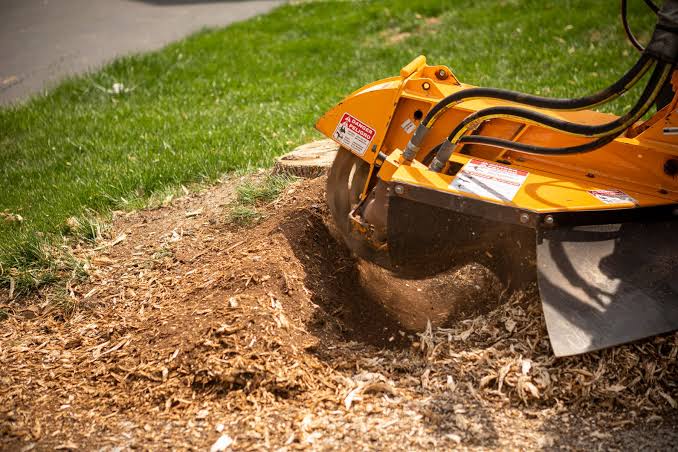
Stump location is often as important as its appearance. A stump in an open area presents different planning questions from one behind a narrow gate, beside a fence, near a patio, on a slope, within a landscaped bed, or close to another property feature.
Before requesting an estimate, note:
- the private property address;
- how many stumps are involved;
- where each stump sits relative to gates, fences, structures, surfaces, and boundaries;
- the narrowest obvious access point, without attempting unsafe measurements;
- whether steps, slopes, soft ground, irrigation, or landscape features may affect access;
- visible surface roots that matter to the planned use; and
- what you want the area to be used for afterward.
Photos from several safe positions may help a provider understand the setting. Include the path to the stump as well as the stump itself. A close-up that hides the gate, slope, nearby wall, or landscaped area may not communicate the part of the property that most needs discussion.
Do not move utility markers, dig around concealed lines, or make assumptions about what lies beneath the surface. Ask what information or marking is required before work is scheduled.
Cost Guide 04
Grinding Depth and Root Expectations Must Be Written
“Below ground” is not a complete finish description. The appropriate conversation is about the intended use and the agreed written scope. Ask what depth expectation is proposed and how it will be described in the estimate.
Roots need separate attention. Grinding a stump does not automatically mean removing an entire root system. If visible surface roots interfere with the intended use, identify the specific roots and ask whether they are included, excluded, or require a different decision. Fort Bend Tree Pros does not publish a root-removal promise.
Use a three-part finish question:
- What will be ground? Identify the stump and any specifically included visible roots.
- To what stated result? Define the depth or finish expectation in terms the proposal can verify.
- What happens next? Clarify grindings, debris, the resulting depression, backfill, leveling, soil, sod, landscaping, and restoration as included or excluded items.
This structure prevents an owner’s intended future use from becoming an unwritten assumption.
Cost Guide 05
Grindings, Backfill, and Restoration Are Separate Scope Questions
After grinding, the area may contain grindings or a depression. What happens next should be decided before the proposal is accepted. Ask whether the written scope addresses:
- leaving grindings in place;
- moving or removing material;
- debris from the immediate work area;
- filling or leveling the depression;
- imported soil or other material;
- sod, seeding, planting, paving, or landscape restoration; and
- responsibility for later settling or surface changes.
These are not stated inclusions. Some may not be offered at all. The purpose of the checklist is to turn the desired finish into an explicit answer rather than a post-work disagreement.
If the stump follows a separate removal project, compare the removal and grinding documents together. Verify that the same stump is identified and that no task is assumed to belong to both scopes or to neither.
Cost Guide 06
How to Compare Stump Grinding Quotes
The Texas Attorney General’s consumer guidance recommends putting total cost, work scope, schedule, payment terms, and expectations in writing, reading the agreement, and avoiding blank spaces. Apply those principles to the finish details that make stump proposals different.
| Comparison point | Like-for-like check |
|---|---|
| Number and identity | Do both proposals cover the same stump or stumps? |
| Access | Did both account for the same gate, slope, surface, or approach limits? |
| Depth | Is the finish or depth expectation stated in both? |
| Roots | Are the same visible roots included or excluded? |
| Material | Do both say what happens to grindings and debris? |
| Surface condition | Are backfill, leveling, soil, sod, or restoration treated the same way? |
| Utilities/irrigation | Are owner and provider responsibilities clear? |
| Timing/payment | Are schedule, payment stages, completion, and changes written? |
A lower total may cover a narrower finish. A higher total may include work the other proposal excludes. Ask each provider to clarify the document instead of guessing why the totals differ.
Any claim about a provider’s credentials, insurance, experience, equipment, or other qualification should be supported by current evidence. This guide does not state that Fort Bend Tree Pros holds any unverified credential or coverage.
Cost Guide 07
Prepare the Property Information, Not the Work Area
Estimate readiness does not require digging, cutting roots, opening an unsafe area, or changing the property. Prepare information instead:
- Count and identify the stumps.
- Photograph each stump and the access route from safe positions.
- Describe the intended use of the area.
- Note visible roots and nearby property features.
- Gather any known utility, irrigation, or site information.
- List the finish questions that matter to you.
- Ask for the complete scope, exclusions, schedule, payment terms, and change process in writing.
This gives each provider a consistent starting point while leaving site verification and work planning to the estimate process.
Cost Guide 08
Request a Scope-Specific Estimate
Fort Bend Tree Pros offers stump grinding for eligible projects in its Fort Bend County, Texas service territory. The service description does not promise a particular grinding depth, root removal, debris removal, backfill, restoration, equipment, price, or response time.
To discuss a remaining stump, contact Fort Bend Tree Pros or call (281) 953-6277. Share the location privately, number of stumps, access route, visible roots, nearby features, and intended use. Coverage and scheduling must be confirmed before service is arranged.
Prepare Once, Compare Better
Make the intended finish clear before comparing quotes
Share the private service location, what you can observe safely, nearby property or access constraints, and the outcome you want to discuss. A written scope should define inclusions, exclusions, timing, and how changes are approved.
- Use one description for every estimate request.
- Photograph only from a safe location.
- Identify utility, public-area, and access concerns early.
- Compare the proposed result—not the total alone.
Prefer to call? (281) 953-6277
Common Questions
Estimate and pricing questions
Use these answers as a starting point, then confirm the exact property, responsibility, and written scope.
How much does stump grinding cost in Fort Bend County?
Fort Bend Tree Pros does not publish an unverified average or price range. A written estimate should identify the exact stump or stumps, access, agreed grinding-depth expectation, visible-root scope, grindings or debris, intended surface condition, utilities or irrigation concerns, schedule, payment terms, and change process.
Is root removal included with stump grinding?
Do not assume root removal is included. Identify any visible surface roots that matter to the planned use and ask the estimate to state which roots are included or excluded. Stump grinding does not automatically define treatment of the entire root system.
What happens to the grindings after the stump is ground?
The written scope should say whether grindings remain, are moved, or are handled another way. It should also state whether filling, leveling, soil, sod, landscaping, or restoration is included or excluded rather than leaving the final surface condition to assumption.
Can a stump grinding price be confirmed from one photo?
One photo may not show the access route, gates, slope, nearby surfaces, visible roots, utilities, irrigation, or intended finish. Safe photos of the stump and its surroundings can support the request, but the provider should confirm what site information is needed for a final written estimate.
Is stump grinding automatically part of tree removal?
No automatic inclusion is stated. Tree removal and stump grinding are separate service intents. If both are requested, the estimate should identify the standing-tree scope, stump scope, exclusions, schedule, and total for each or clearly explain how they are combined.
Request a Scope-Based Estimate
Request a Stump Grinding Estimate With the Finish Defined
Describe the visible concern and intended outcome. Fort Bend Tree Pros will confirm service-area coverage and whether more information or an on-site review is needed before the written scope and price are finalized.