Fort Bend Tree Guide
Oak Wilt Guidance for Katy and Fort Bend County Property Owners
Learn the Texas A&M Forest Service guidance for preventing oak wilt, recognizing warning signs, and responding safely in Katy and Fort Bend County.
- Fort Bend County service territory
- Written scope for comparison
- Coverage confirmed per request
Quick Guide Summary
Start with source-backed guidance and the actual property condition
Quick answer: Oak wilt is a serious Texas tree disease. Texas A&M Forest Service advises property owners to avoid pruning or wounding oaks from February through June and to paint fresh oak wounds immediately, regardless of season. A symptom list cannot confirm oak wilt, so suspected cases should be evaluated by an appropriately qualified tree-health professional.
This guide explains prevention and safe next steps. Fort Bend Tree Pros is not presented here as an oak-wilt diagnosis, injection, trenching, or treatment provider. Our approved services are tree trimming and pruning, tree removal, stump grinding, and emergency response, subject to confirmed property coverage and written scope.
Guide Step 01
What Oak Wilt Is
Oak wilt is a vascular disease caused by the fungus Bretziella fagacearum. The disease interferes with water movement inside an infected oak. Texas A&M Forest Service describes oak wilt as one of the most destructive tree diseases in the United States and reports that it has killed millions of trees in Texas.
The disease can move between trees in two main ways:
- Overland spread to a fresh wound. Sap-feeding beetles can carry fungal spores from an infected red oak to a recent wound on another oak.
- Underground spread through connected roots. Closely growing live oaks can share root connections, allowing the disease to move through a group of trees.
Those pathways are why prevention guidance focuses on avoiding wounds during the highest-risk months, painting fresh oak wounds, handling suspect wood carefully, and obtaining qualified help when a group of oaks declines.
For the current state guidance, see the Texas A&M Forest Service resources on preventing oak wilt and the Texas Oak Wilt Management Program.
Guide Step 02
Warning Signs That Deserve Attention
Symptoms vary by oak group and may resemble drought stress, storm damage, construction injury, or other diseases. Do not diagnose a tree from one leaf or a web photo.
Property owners can safely observe from the ground for patterns such as:
- rapid leaf discoloration or leaf drop during the growing season;
- brown or yellow areas that follow leaf veins on a live oak;
- sudden decline in a red oak;
- several nearby live oaks declining one after another;
- an expanding group of affected trees rather than one isolated branch; or
- fresh wounds on oaks during the February–June risk period.
A single symptom is not proof of oak wilt. The Texas Oak Wilt Management Program provides current identification and management resources and explains when laboratory confirmation or an oak-wilt-qualified professional may be appropriate.
If a limb is hanging, a tree is leaning unexpectedly, or damage is close to an occupied area, treat the physical hazard separately from the disease question. Keep people away from the drop zone. For a line-related emergency, contact 911 and the property’s actual electric utility before private tree work begins.
Guide Step 03
Avoid Planned Oak Pruning From February Through June
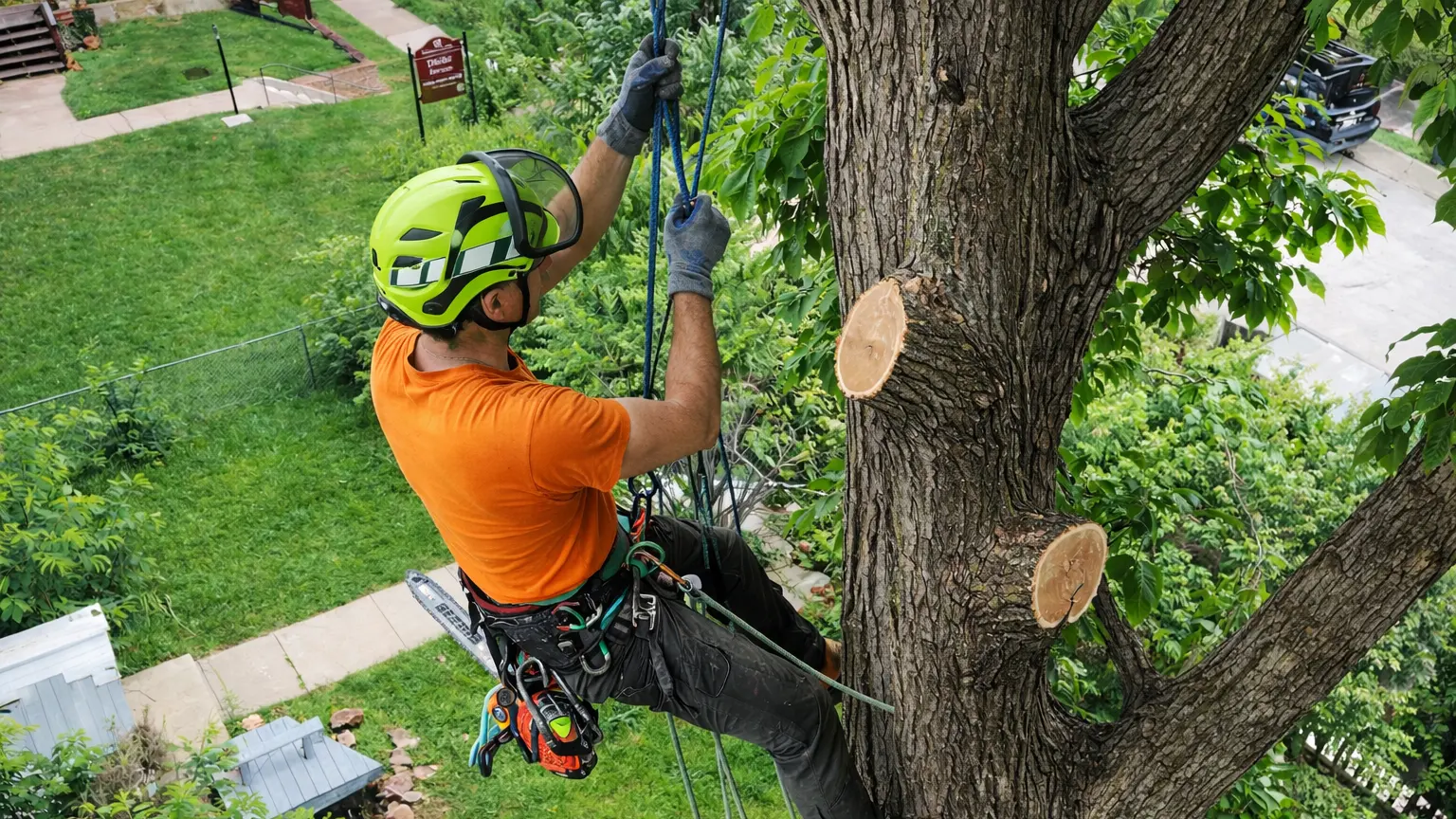
Texas A&M Forest Service advises avoiding pruning or wounding oak trees from February through June. Fresh wounds can attract the insects that help move the fungus overland.
For routine work that can wait:
- do not schedule planned oak pruning during February, March, April, May, or June;
- identify the exact tree and the reason for each proposed cut;
- avoid unnecessary cuts; and
- paint every fresh oak wound immediately, regardless of season.
This guidance does not mean every date outside February–June is automatically suitable for every tree. Tree condition, storm damage, safety, weather, pruning objective, and proposed crown reduction still matter. Our separate guide explains when to trim oak trees in Texas without inventing a narrower universal window.
Guide Step 04
What to Do After Storm Damage
Storm damage does not follow a calendar. If an oak is broken or blocking access during the higher-risk period, safety comes first.
- Keep people and pets outside the affected area.
- Do not stand under a cracked or hanging limb.
- Do not climb the tree or cut a sample for identification.
- Treat every downed or nearby utility line as energized.
- Photograph the condition only from a safe location.
- Tell the provider that an oak is involved and when the damage occurred.
- Ask how the immediate safety scope will be separated from later routine pruning.
- Confirm that fresh oak wounds will be painted immediately.
For a fallen tree, broken limb, storm damage, or blocked access, review our emergency tree service information. Coverage, crew availability, and the exact work scope must be confirmed.
Guide Step 05
Do Not Turn Prevention Advice Into DIY Treatment
Oak-wilt management can involve specialized diagnosis and control measures. The Texas Oak Wilt Management Program describes integrated approaches that may include red-oak sanitation, root-graft disruption, and fungicide treatment in appropriate cases. Those are not do-it-yourself instructions and are not services claimed by Fort Bend Tree Pros on this page.
If oak wilt is suspected:
- avoid creating new wounds to investigate;
- do not move suspect firewood to another property;
- document the location and pattern from a safe distance;
- consult current Texas A&M Forest Service or Texas Oak Wilt resources; and
- seek an appropriately qualified professional for diagnosis or treatment decisions.
A tree that is already dead, structurally compromised, or presenting a confirmed physical hazard may still require a separate removal estimate. That estimate should identify the tree, access, nearby structures, debris handling, stump work, and exclusions. It should not imply that removal alone controls disease spread.
Guide Step 06
Questions to Ask Before Tree Work
Whether the request is preventive pruning, removal of a failed tree, or storm response, a written proposal should answer:
| Question | Why it matters |
|---|---|
| Which tree and which limbs are included? | It prevents a broad “trim everything” scope. |
| Is this routine work or an immediate safety response? | The urgency and the pruning decision are different. |
| Is the tree an oak? | Oak-wilt wound guidance applies. |
| When will the work occur? | Planned oak pruning should avoid February through June. |
| How will fresh oak wounds be handled? | Texas guidance calls for immediate wound painting. |
| Are lines, roofs, fences, or public areas involved? | Responsibility and access must be clarified first. |
| What happens to wood and debris? | Disposal and any disease-related handling should not be assumed. |
| What is not included? | Diagnosis, treatment, permits, restoration, and later work require explicit scope. |
For routine pruning, use the tree trimming and pruning service page. If removal is the primary need, review tree removal in Fort Bend County.
Guide Step 07
Request an Estimate for Approved Tree Work
For an eligible property in the Fort Bend County service territory, request an estimate or call (281) 953-6277 for tree trimming, tree removal, stump grinding, or emergency response. State that an oak is involved and whether you suspect disease. We will confirm whether the requested physical tree work is within service scope; oak-wilt diagnosis and treatment are not represented as approved services.
Prepare Once, Compare Better
Turn the property details into a clearer first conversation
Share the private service location, what you can observe safely, nearby property or access constraints, and the outcome you want to discuss. A written scope should define inclusions, exclusions, timing, and how changes are approved.
- Use one description for every estimate request.
- Photograph only from a safe location.
- Identify utility, public-area, and access concerns early.
- Compare the proposed result—not the total alone.
Prefer to call? (281) 953-6277
Common Questions
Practical guide questions
Use these answers as a starting point, then confirm the exact property, responsibility, and written scope.
What months should I avoid pruning oaks in Texas?
Texas A&M Forest Service advises avoiding pruning or wounding oaks from February through June.
Should a fresh oak wound be painted?
Yes. Texas A&M Forest Service advises painting fresh oak wounds immediately, regardless of season.
Can leaf browning confirm oak wilt?
No. Browning, leaf loss, and decline have multiple possible causes. A symptom list or photograph is not a diagnosis.
Does Fort Bend Tree Pros diagnose or treat oak wilt?
No oak-wilt diagnosis, injection, trenching, or treatment service is claimed here. The approved service scope is tree trimming and pruning, tree removal, stump grinding, and emergency response, subject to coverage and a written proposal.
Where can I find authoritative Texas oak-wilt guidance?
Use the Texas A&M Forest Service and Texas Oak Wilt Management Program resources for current prevention, identification, and management information.
Request a Scope-Based Estimate
Request a Written Scope for Approved Tree Work
Describe the visible concern and intended outcome. Fort Bend Tree Pros will confirm service-area coverage and whether more information or an on-site review is needed before the written scope and price are finalized.